Crafting Systems
As previously mentioned, I've been playing TTRPG games for quite a while, and started modifying/designing them about six or seven years ago. In that time I’ve come across a lot of different approaches to the same ideas by different homebrew developers. Interestingly, I've noticed that there are an unusually high number of homebrew rules for crafting systems, usually as the designer's first project. I figured this would make for a good subject to start talking about tabletop development.
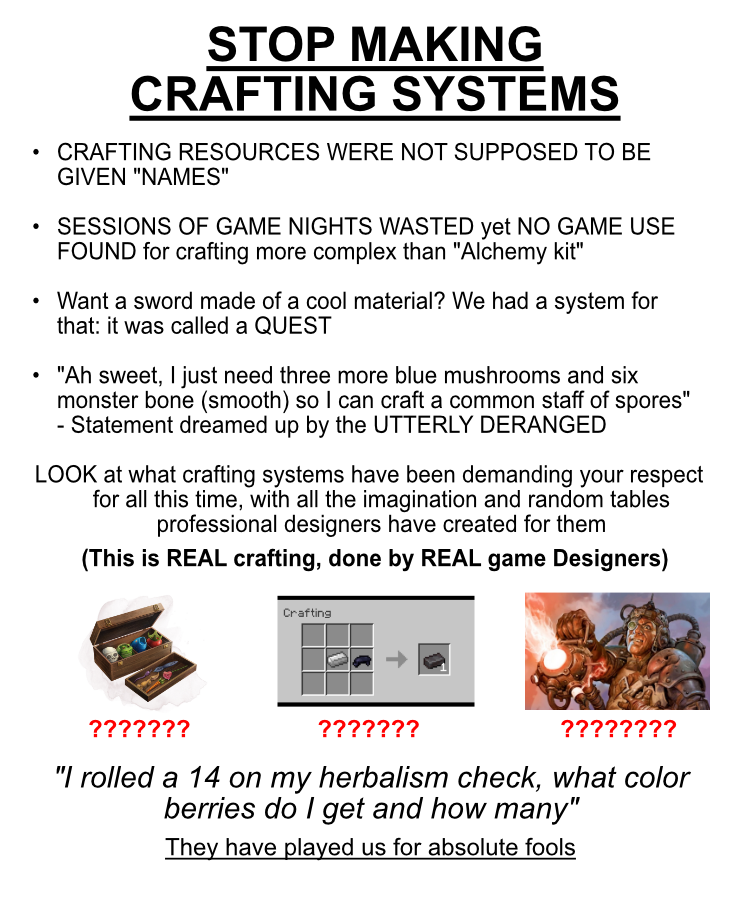
The most common approaches you'll encounter for crafting systems resemble systems you might encounter in a video game. That is to say, you need specific resources which are combined to create items. At this point, we've already run into a design problem with how a typical tabletop game plays out. While the distribution of resources is something that a game can handle automatically in something like an MMO, in a tabletop game it’s ultimately down to the dungeon master to describe what there is for players to interact with and facilitate their actions with the world in real time. This means that for each player that wants to craft, say, a healing potion, we enter a loop of of asking where to find the resource, asking to collect said resource, repeating for other required resources, and then asking to craft the item. The actual process of all this is difficult to fit naturally into the flow of a game, particuarly when you have players interrupting your train of thought by asking to make fungus harvesting checks because you stupidly put a mushroom covered log on the battlemap for decorative purposes, meaning you need to take a 5 minute break to go consult your list of mushrooms to figure out what color mushroom you want to distribute in this area (and while you're doing that, you get a sinking feeling about the herb-shaped plants on your next map).
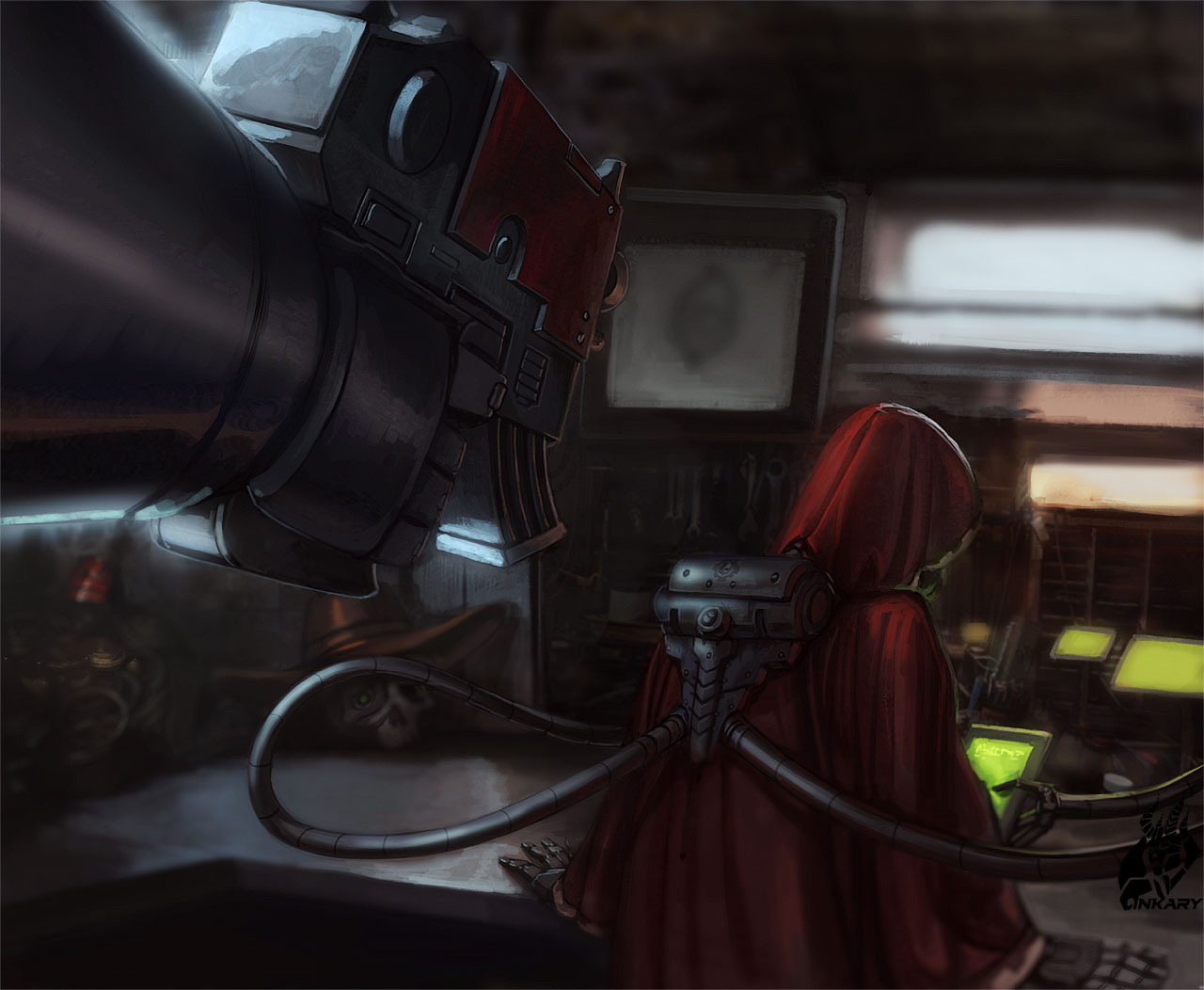
I'm not saying that I think crafting rules can’t work in a tabletop game, but any systems you develop must fit to the strengths of the medium of which you are designing for. The best implementation of a TTRPG crafting system I’ve personally seen was during a Dark Heresy campaign where we came up with a plan that required our tech-Magos creating a t-shirt cannon (it was one of those campaigns). The DM made the following ruling: “This guy in the market sells boxes of junk. If you want to craft something, I’ll tell you how many boxes of junk it costs to make it, and you can make a Tech-Check to see if you can make it”. This was a blast to play with because it skipped straight to the creative step of describing what we were making (and how we made it), rather than ask/response routine of gathering the resources. Boxes of junk became a staple in that campaign because depending on how we rolled on our checks, it enabled all sorts of alternate solutions to problems, with the DM adding special rulings as the specific idea required it.
What I like about this approach is that it's easy to remember for players, and easy for a DM to run while focusing on other aspects of the game. Need a scope for a weapon? One junk box. Need to set a trap? One box of junk, and a weapon for the damage we wanted it to deal. You could even try implementing different sets of generalized resources to fit your campaign, or be more detailed in what the materials they gather look like when gathering them (while not restricting their function in crafting). A player wants to be an alchemist and brew a specific potion? That’ll be 3 units of alchemical materials. Want to craft a sword in your downtime? That’ll be two boxes of crafting parts. Oh, those Crafting parts are labeled "dragon bones" from when you asked the DM if you could loot that dragon skeleton four weeks ago? Sounds like you have a sword made of dragon bones. These are just a few examples off the top of my head, but you can tweak these to fit your specific game's playstyle pretty easily.
The “Box of Junk” approach is great in that it plays to the strengths of a tabletop game. A DM can also run the crafting rules without being bogged down in the minute details, allowing them to focus on other aspects of the game. A skilled dungeon master might even say that something a player really wants to craft can only be made using a resource from a specific location or creature, creating a plothook for their next adventure.
One of the interesting things is that when we compare this to the crafting systems from video games, we can see some similarities in how both approaches accomplish the same goals, but the differences that suit their appropriate medium. I think a fun exercise would be to consider what the implications would be of implementing a game mechanic into a different medium "as is". The box of junk approach, for example, wouldn't work as well in a video game due to the computer not having the creative capacity to handle the varying requests, and the specific recipe system from a video game requires too much computation to run effectively at a tabletop game.